The WISER Method
Mastering perpetual innovation using AI First Principles
Why WISER Exists
Most teams don't stall because they picked the wrong tool. They stall because changing anything feels riskier than living with what's already broken.
So the workarounds stay. The process nobody likes stays. Competitors replace the system you're still maintaining, and maintaining it keeps looking like the safe call right up until it isn't.
AI can break that stalemate, but only if you dismantle the bureaucracy instead of automating it. Bolt AI onto a broken process and you scale the mess. And because you can't pause operations to rebuild from scratch, you need a way to fix what's broken without stopping what works.
That is the problem WISER is built for.
The Worldview
Three commitments that decide every call the method makes.
Action over theory
Trust what can be proven, not what can be planned. Evidence settles arguments that opinion never will.
Evolution over disruption
Rebuild the system while it runs. No shutdown, no rewrite, no eighteen-month replatform that lands late and wrong.
People over proxies
The experts are the people doing the work, not the people documenting it. Go to them first.
What You Get
Teams operating on WISER end up with four capabilities they did not have before.
Continuous evolution
Rebuild systems while they run. Change stops being an event you schedule and becomes something the team just does.
Systematic risk burn-down
Find the highest-risk item, reduce it with evidence, move to the next. Risk comes down in order instead of all at once at the end.
Living documentation
A Playbook that absorbs every outcome, so the team stops relearning what it already knew.
Clear ownership
Every decision has a person accountable for it, even as AI takes on more of the work.
How It Works
WISER builds momentum through systematic risk burn-down. Find the highest-risk item, reduce it through evidence and iteration, then move to the next one.
Bounded improvements do two jobs at once. They reveal how the system actually behaves, and they prove what works. That proof buys capability. Capability creates decisions, decisions drive action, and action expands capability again.
The cycle feeds itself, but only if you have structure to keep it from turning into chaos. That structure is the rest of this page.
Four Parts, One System
WISER is a system, not a checklist. Each part does a job the others can't.
Canons
The strategic spine. Five moves that carry a team from observation to scale.
Plays
Tactics for a specific domain. They adapt the strategy to the reality in front of you.
Playbooks
The memory. Current state, objectives, and boundaries written down so nothing has to be relearned.
Positions
Human accountability. Nine tensions, each owned by a named person.
The Canons
Five moves: Witness, Interrogate, Solve, Expand, Refine. They run in that order, and iteration is expected rather than treated as failure.
Something you find in Expand may send you back to Interrogate to retest an assumption. That is the method working, not the method breaking. Structure that permits discovery is what lets a team think laterally at scale without the whole thing coming apart.

Witness
Observation reveals what planning conceals.
This phase begins here because documentation theater often hides the workarounds and hacks that keep systems running. Optimizing based on the official process often means optimizing fiction. Witness demands mapping the friction people actually feel, forcing the solution to address real problems rather than theoretical ones.
Principles: Build from User Experience · Reveal the Invisible · Discovery Before Disruption · Deception Destroys Trust

Interrogate
Observation finds pain. Experiments find causes.
This phase exists to avoid the most common failure mode: building the wrong solution perfectly. Instead of committing to months of development, rapid experiments reveal root causes. The goal is not to guess what is broken, but to force the system to reveal it.
Principles: Iterate Towards What Works · Reveal the Invisible · Build from User Experience · AI Inherits Messiness · Ambiguity Is Wisdom · Deception Destroys Trust

Solve
Experiments find causes. Solutions earn trust.
The focus is on delivering a single, working solution that demonstrates undeniable value. Working software settles arguments. This approach secures the organizational permission required to touch critical systems by delivering a win that matters.
Principles: Iterate Towards What Works · Reveal the Invisible · Build from User Experience · Justify Resource Consumption · People Own Objectives · Deception Destroys Trust

Expand
Earned trust enables systematic change toward autonomy.
Modularizing the successful component allows it to solve related problems while maintaining explicit human oversight. This scales the solution's reach without introducing the systemic risk that comes from all-or-nothing deployments.
Principles: Decompose Incrementally · Reveal the Invisible · Build from User Experience · Justify Resource Consumption · AI Fails Silently · People Own Objectives · Deception Destroys Trust

Refine
Autonomy is not designed, it is grown.
AI autonomy increases as reliability is proven. Trust is earned, not designed. Agency transfers to the system as it proves it can make the decision correctly without breaking the boundaries defined in your Playbook.
Principles: AI Inherits Messiness · Reveal the Invisible · Build from User Experience · Justify Resource Consumption · Decompose Incrementally · AI Fails Silently · Deception Destroys Trust
Plays and Playbooks
Plays
Plays turn the framework into tactics for a specific context. Instead of a blank page, a builder starts with a pattern that already worked somewhere similar.
They come at three levels of specificity: domain (healthcare, financial services, manufacturing), context (startup, enterprise, regulated industry), and generic. None of them are rules. They are starting points you adapt, and the adapted version goes back to the community as a new Play.
Plays also define how a Playbook gets structured and how Positions get filled for your context.
Playbooks
A Playbook is the memory that survives the chaos. Current state, objectives, and boundaries in one place, so what you learned in Solve is still there when you reach Expand.
Traditional plans execute once and collect dust. A Playbook absorbs every outcome instead. Run a Play, see what happens, update the Playbook. What worked becomes doctrine. What failed becomes warning.
Making risks and constraints explicit is what prevents the organizational amnesia that kills momentum.
Nine Accountabilities
Principle-driven tensions don't resolve themselves. Someone has to own the call when the team can't agree, and someone has to speak for users when builders optimize for elegance. Positions assign these nine to named people; on a small team one person carries several.
Authority
Who decides what gets built.
Empathy
Whether the system serves the people using it.
Translation
Whether the system can be understood by the people who have to understand it.
Context
Historical knowledge that keeps the team from repeating a mistake it already made.
Skepticism
Pursuing what is true over defending what is believed.
Execution
Building instead of planning to build.
Safety
What could go wrong, and what boundary stops it.
Stewardship
Whether the capability justifies what it costs.
Integrity
Following the method when cutting the corner would be easier.
Where to Start
The method is free. All of it, under CC BY-SA 4.0, templates included. Read it here or take the whole thing from GitHub and adapt it inside your organization without asking anyone's permission.
Most teams begin the same way. Pick the process everybody complains about and run Witness on it. Map what people actually do, not what the documentation claims they do. What turns up there usually tells you what to fix first.
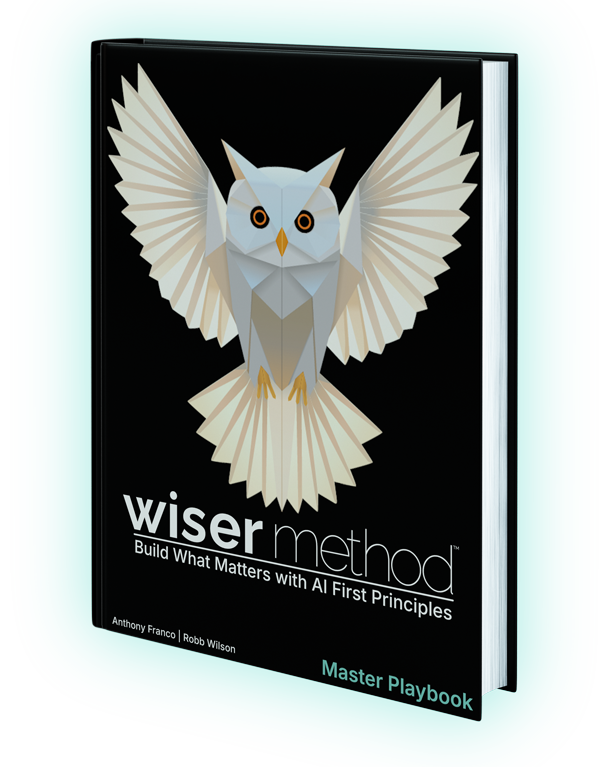
The Master Playbook
The complete methodology. One book.
Five canons. 26 Plays. A full narrative case study. 35 downloadable templates. Everything you need to operationalize AI, from the team that built it at enterprise scale.
Go Deeper
The complete methodology lives in the Master Playbook. The templates and the open-source release are free to take with you.
The Book
Master Playbook
Five canons, 26 plays, 35+ templates, and a full case study. The methodology in book form.
Learn MoreTemplates
Practitioner Templates
The 35 templates that accompany the method. Download them and put the first play to work.
Learn MoreOpen Source
Take the Method With You
The complete methodology under CC BY-SA 4.0. Read it, adapt it, share it with attribution.
Learn More